
PBMs, Controversial Practices, and Efforts to Reform in 2026
- Robert Kotcher, PA Patient Advocate
Pharmacy benefit managers sit between you, your insurer, and drug makers—and shape what you pay. Learn how PBMs make money, why prices feel irrational, and what 2026 FTC and federal reforms aim to change.
Free Patient Advocate Help
Get help with prescription coverage and costs
Tell us what is going on with your plan or pharmacy and we can help you understand PBM-driven barriers and realistic options.
A simple but shocking claim
Prescription drug prices feel random—but they are not. The amount you pay at the pharmacy counter is often less about the drug itself and more about a complex web of behind-the-scenes negotiations. At the center of that system are pharmacy benefit managers (PBMs): companies most people have never heard of, yet they quietly determine which drugs are covered, how much they cost, and who profits along the way.
According to a recent FTC interim staff report on PBMs, the largest PBMs marked up several specialty generic drugs dispensed at affiliated pharmacies by thousands of percent.
This article explains what a PBM is, practices that are widely considered controversial, and legislation and enforcement that are tackling these issues in 2026.
But what even is a PBM?
PBMs are companies that sit between your pharmacy, the drug manufacturer, and your insurer to manage prescription drug benefits.
- Decide which drugs your insurance covers.
- Negotiate prices and rebates with drug manufacturers.
- Determine how much you pay at the pharmacy.
- Process and pay pharmacy claims.
- Implement controls like prior authorization and step therapy.
The PBM system map
Here is a simplified version of what happens when you fill a prescription: your doctor sends the prescription to the pharmacy; the pharmacy sends the request to a PBM, not directly to the insurer; the PBM responds with the price to charge you; your pharmacy keeps your copay plus reimbursement from the PBM.
What you do not see is the much larger set of financial flows behind the scenes—manufacturer rebates, insurer payments, and PBM profit mechanisms. The diagram below summarizes how drugs move (purple) versus how money moves (green), with the PBM at the center of reimbursement and rebate flows.
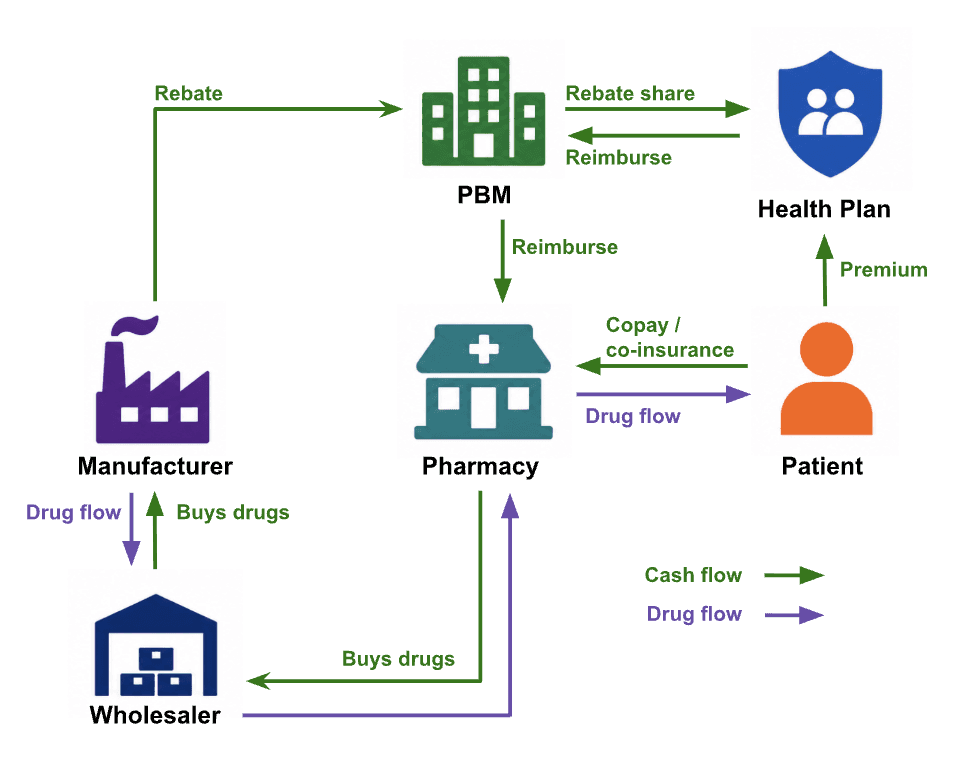
The PBM sits in the middle and controls three big decisions: what drugs are used, what everybody gets paid, and how money moves.
In the next section, we look at how PBMs make money from that position.
How PBMs actually make money
PBMs are not just middlemen—they are businesses. They earn revenue in several ways that are not always transparent to patients and that can influence downstream prices.
Rebates: PBMs negotiate with manufacturers so that, after a drug is dispensed, the manufacturer sends the PBM a rebate. Because higher list prices can support larger rebate dollars, PBMs may have a financial incentive to favor higher-priced products over cheaper alternatives when formulary placement is at stake.
Spread pricing: The PBM may charge the insurer more for a drug than it reimburses the pharmacy, keeping the difference.
Administrative fees: PBMs charge insurers and employers fees for various services.
Formularies: A formulary is your plan's preferred drug list. Placement on that list strongly affects utilization—and drugs tied to larger rebates can receive more favorable tiering.
Why drug prices seem irrational
Retail prices often do not track manufacturing cost. Instead, they reflect a tangle of incentives that are hard to see from the outside.
Manufacturers may raise list prices in part because higher list prices can fund larger rebates, which can help a product win preferred formulary placement. Patients with coinsurance then pay a percentage of that inflated list price, which can feel disconnected from the underlying economics.
Copay assistance programs—Humira is a well-known example—can reduce what commercially insured patients owe at the counter, sometimes close to zero, while the list price on paper stays very high. That can be welcome for insured patients but offers no help to uninsured patients who may face cash prices of thousands of dollars per fill.
The controversies
As PBMs have grown more powerful, they have drawn more scrutiny. Critics argue the rebate-driven model can contribute to higher list prices rather than lower net costs for everyone. Federal investigations have alleged that rebate competition has artificially inflated prices in categories such as insulin, where PBMs were accused of favoring higher-rebate brands over lower-priced options.
In 2024, the FTC sued the three largest PBMs over alleged anticompetitive and unfair rebating practices related to insulin. Context matters: the average list price of Humalog was about $21 in 1999 and about $274 by 2017, while PBMs collected billions in rebates and surveys suggested many insulin users struggled to afford treatment.
Independent pharmacies often argue they are squeezed by low reimbursements and by steering that favors PBM-affiliated mail and retail networks.
Policy and reform landscape
On February 4, 2026, the FTC announced a settlement with Express Scripts and affiliates aimed at expanding access to lower-priced medicines—including insulin—across Express Scripts formularies and at changing financial incentives so that choosing pricier drugs is less attractive. Read the FTC press release on the Express Scripts settlement for the full details.
Separately, the 2026 Consolidated Appropriations Act includes major PBM-related provisions summarized clearly by coverage counsel; see Hall Render's overview of federal PBM reform for a practical walkthrough. Highlights often discussed include:
- Rebate “delinking”: Starting in 2028, Medicare Part D is to move toward compensating PBMs through bona fide service fees rather than compensation tied to drug price.
- 100% rebate pass-through: PBMs serving many employer-sponsored plans must remit all rebates to the health plan.
- Any willing pharmacy: Starting in 2029, Medicare Part D networks are to allow any willing pharmacy to participate, limiting exclusive steering toward affiliated pharmacies.
Conclusion: the one insight most people miss
The simplest insight is also the most important: PBMs are not background clerks processing claims. They are central decision-makers for which drugs get used, how dollars flow, and what many patients ultimately pay.
Once you see that role clearly, oddities of the system—wild price variation, dominance of high-list products, and unpredictable out-of-pocket costs—start to look less like random noise and more like the output of incentives that were long opaque.
The open question is whether 2026-era reforms can push those incentives toward transparency and lower patient costs, or whether the system will keep evolving in ways that remain hard to see from the pharmacy counter.
Content is written by patient advocates and healthcare professionals, not AI. This helps us ensure we're providing accurate information. Questions or comments? Email support@guidemyclaim.com.
Free Patient Advocate Help
Get help with prescription coverage and costs
Tell us what is going on with your plan or pharmacy and we can help you understand PBM-driven barriers and realistic options.